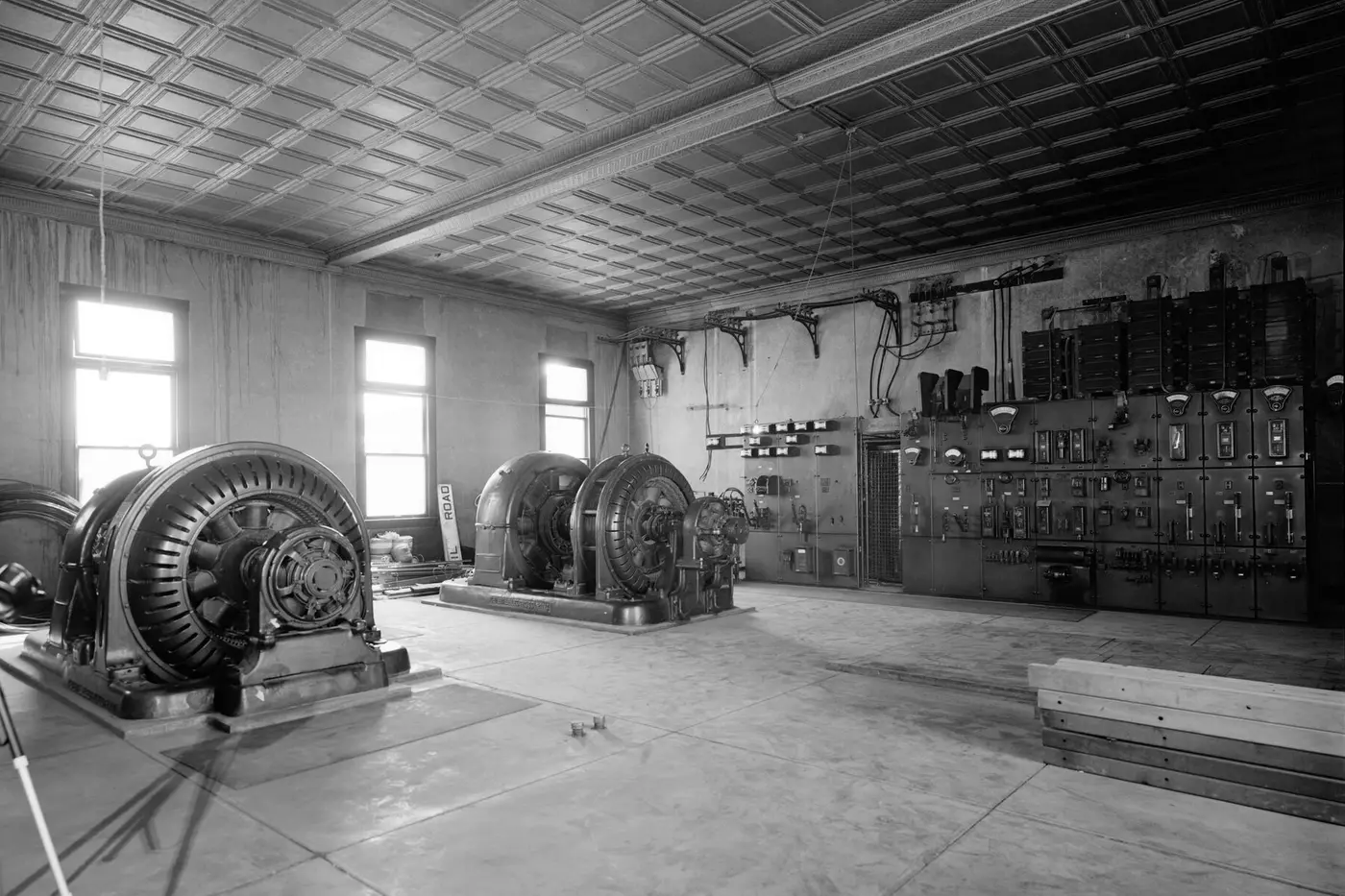
Buildings were designed around people. Floor loads assumed desks and filing. Ventilation assumed breathing. Power assumed lights and a computer per person. Fire strategies assumed paper, furniture and fit-out.
A growing share of what occupiers bring through the door is not people. It is servers and network equipment, robotic picking systems, battery storage, charging banks for vehicles and forklifts, sensors and the infrastructure that connects them. Machines are a new kind of tenant, and they are demanding ones.
Machines want power and cooling
Machines convert electricity into work and heat. A rack of modern computing equipment can draw as much power as a whole floor of office workers once did, and all of it ends up as heat that must be removed. An automated warehouse runs conveyors, shuttles and chargers continuously. A fleet depot may need more power at night than the building uses all day.
The building’s supply, switchboards, distribution and cooling plant were sized for a different load profile. Adding machines often means adding capacity, and as Energy Becomes a Building Function sets out, capacity is now one of the hardest things to add.
How dense the machines have become
The pace of change is easiest to see in computing racks, the clearest case of a machine asking more of a building than people ever did.
| Measure | Reading | Source |
|---|---|---|
| Average rack density, excluding purpose-built high-density sites | About 7.5 kW (2025) | Uptime Institute Global Data Center Survey |
| Most common rack density | About 11 kW (2026), up from 9 kW | Uptime Institute, 2026 survey |
| Operators whose densest rack is below 30 kW | 82% (2025) | Uptime Institute |
| Operators with a rack of 50 kW or more | 9% (2025) | Uptime Institute |
| Point at which liquid cooling is typically used | Above about 50 kW per rack | Uptime Institute |
| Leading AI racks | 100 kW and more, with designs moving towards several hundred | Uptime Institute |
Uptime Institute survey data as reported by Data Center Knowledge and others.
For a building that was never designed as a data hall, the lesson is that a single AI rack can draw what an entire floor of offices once did, and reject the same heat into one small room. Hosting that is a question of supply capacity, cooling plant, structure and, increasingly, water for liquid cooling, not of floor area.
Battery rules by market
The fire question has its own standards, and they differ. In the United States, NFPA 855 governs the installation of stationary energy storage systems. In Australia, AS/NZS 5139 covers battery systems connected through inverters, mainly at smaller scale, with larger installations relying on fire engineering and insurer requirements. In Britain, PAS 63100 sets out fire protection for domestic battery storage, and commercial installations rely on fire engineering and insurer guidance. For an owner, the consistent points are separation, ventilation, detection and access for firefighters, and an insurer who has been told before the system is installed, not after.
Machines want the floor to behave
Automated handling systems ask for slab flatness and load capacity that older industrial floors may not meet. Very narrow aisle and high-bay racking concentrates loads at the feet of tall structures. Robots tolerate far less unevenness than forklifts and people. Heavy batteries and equipment cabinets put point loads on suspended floors in offices and mixed-use buildings.
A slab that has served for twenty years can become the reason a building cannot host the next occupier. Floor capacity is rarely on a marketing sheet, and it is expensive to change.
Machines change the fire question
Lithium-ion batteries are the clearest example. Battery storage, e-bike and scooter charging, forklift fleets and vehicle chargers bring a fire hazard that behaves differently from the fires most building fire strategies were designed around. Fire authorities and insurers in all three of our markets have been issuing guidance and tightening expectations on where batteries sit, how they are separated and how fires would be fought.
For an existing building, this can mean new compartmentation, detection, suppression, ventilation or simply a different location for the equipment. It can also mean that an insurer prices the building differently once the machines arrive.
A hosting capacity statement
Owners who expect machine-heavy occupiers benefit from preparing a short hosting capacity statement for each building, drawn from the register. Spare electrical capacity at the main switchboard and the supply, and what increasing it would involve. Cooling headroom in the base-building plant and space for supplementary cooling. Floor loading and, for industrial space, slab flatness and joint condition. Riser and cable path capacity. And the fire strategy’s position on batteries, charging and high-value equipment.
A statement like this answers a prospective occupier’s first questions quickly and honestly. It also tells the owner which buildings to market to which kind of occupier, and which upgrades would widen the field.
What hosting asks of the owner
An owner does not control what occupiers bring, but does control what the base building can support. The useful work is to know the limits before the enquiry arrives: spare electrical capacity, cooling headroom, slab capacity and flatness where relevant, riser space for cabling, and what the fire strategy would need to accept batteries or charging.
Those limits belong in the Capital Strategy as facts and as decisions. Some buildings will host machines easily. Some can with targeted works. Some cannot, and knowing that early is as valuable as knowing the opposite. How much of this reaches ordinary commercial stock, rather than purpose-built facilities, is the open question we are watching.
Sources
Named sources consulted for this paper. Consequential claims link to their source in the text. Reviewed 3 November 2026; next review by 3 November 2027.
- NFPA 855: Standard for the Installation of Stationary Energy Storage Systems, National Fire Protection Association. Accessed 3 November 2026.
- Lithium-ion batteries, London Fire Brigade. Accessed 3 November 2026.
- Energy and AI, International Energy Agency, 2025. Accessed 3 November 2026.
- National Construction Code, Australian Building Codes Board. Accessed 3 November 2026.
- Key Questions on Energy and AI: executive summary, International Energy Agency, April 2026. Accessed 3 November 2026.
- For high-density AI, available data center space may not be usable (Uptime Institute survey data), Data Center Knowledge. Accessed 3 November 2026.
- AI rack density’s real limits: power, cooling, failure risk (Uptime Institute 2026 survey), Data Center Knowledge. Accessed 3 November 2026.
Questions
Why do lithium-ion batteries change a building’s fire strategy?
Battery fires can develop and spread differently from ordinary fit-out fires and can be hard to extinguish. Where batteries are stored or charged, separation, detection, ventilation and suppression may need to change, and insurers may reassess the risk.
Can any warehouse floor take automated handling equipment?
Not necessarily. Automated systems can require tighter floor flatness and higher load capacity than older slabs provide. The slab should be checked against the specific system before committing.